Swifts at Trussell Crescent, Winchester – 2026 update
In 2018, while doing a survey of breeding swifts in Winchester, we discovered a large colony of the birds nesting at Trussell Crescent. Trussell Crescent is made up of two large, curving 3-storey terraces of flats and maisonettes, built by Winchester City Council in Weeke in the early 1950s. This was the only place in Weeke where we found swifts nesting. All the nests were at the back of the Crescent. Swifts were accessing their nests either through gaps in the soffit, or, more commonly, through holes left in the brickworkwhen pipework – perhaps overflow pipes – was removed. In 2018, we saw swifts using 20 such nest sites. Large screaming parties of swifts flying close to the back of the Crescent demonstrated how popular it was with the local swifts as a place to nest.

But although so many swifts were keen to nest at the back of Trussell Crescent, many of the nest sites were potentially hazardous. To access a flat space to make their nest, swifts entering the holes in the brickwork must cross the cavity and presumably many end up under the floors of some of the flats. It’s impossible to know how successful swifts have been in raising chicks to the fledging stage in these conditions. Some birds may have been unable to find their way out.
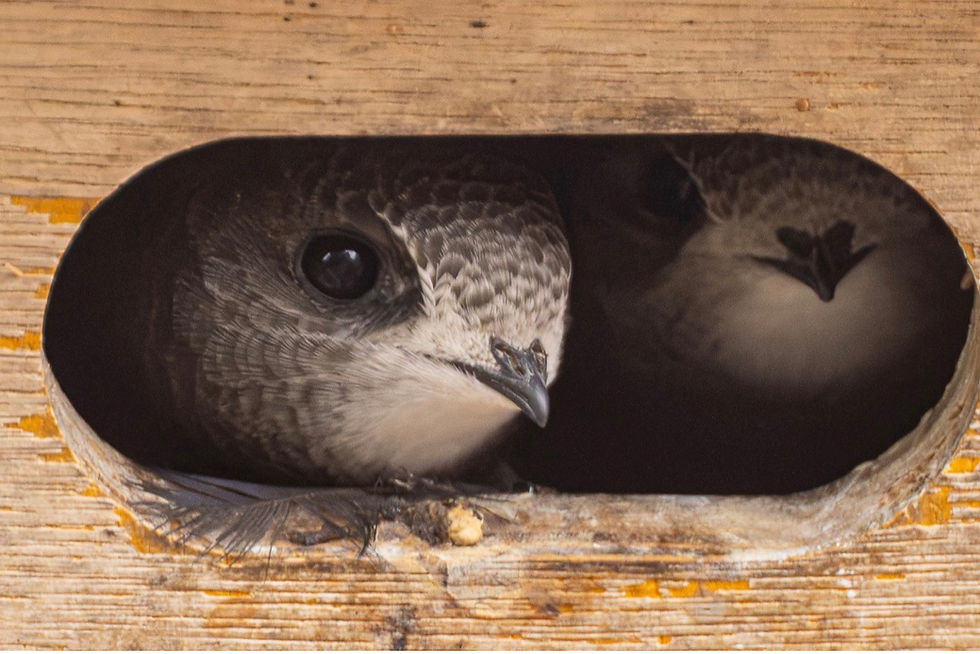
Since 2018, many of the holes in the brickwork at the back of Trussell Crescent have been blocked up. Numbers of potential nest sites for swifts, starlings and house sparrows fell as a result. We were therefore delighted that Winchester City Council – owners of the Crescent – agreed to fund 23 double swift boxes. In 2023, Roger Maynard and Tim Norriss of Hampshire Swifts installed these boxes on the front of the Crescent.
We hoped that swifts prospecting for somewhere to breed would soon start choosing one of these spacious, safe nest boxes in preference to the holes in the brickwork.

By 2025, swifts were already using several of the nest boxes at the front of the Crescent. Of the 46 nest chambers available, 11 had swifts nesting in them that year. We saw three pairs of swifts going in or out of holes in the brickwork at the back of the Crescent. These swifts may have been nesting there before we installed the nest boxes in 2023. Given how faithful swifts are to their nest site, it is unsurprising that these holes in the brickwork are still in use. A 15-year study of swifts nesting in and around the village of Drewsteignton in Devon found that around 94% of individual swifts re-used the same nest site in consecutive years (1).

When we surveyed Trussell Crescent this year, there were still three pairs of swifts accessing nest sites via holes in the brickwork at the back of the Crescent. But the number of pairs of swifts occupying the 46 nest chambers at the front had risen to 19, a 58% increase since 2025. It was noteworthy that whereas last year, the occupied nest boxes were almost entirely clustered at one end of the Crescent, this year swifts have taken up residence in boxes spread from one end of the Crescent to the other.
Another striking feature this year was the size of the swift screaming parties hurtling along the front of the Crescent. On several occasions there were at least 20 birds in these groups. Young, prospecting swifts - also known as ‘bangers’ - were much in evidence, flying up repeatedly to some of the occupied boxes, while the swifts in residence called out in response. It was thrilling to witness.
While surveying I chatted to several residents about the swifts. Although a few seemed indifferent to them or unaware of their presence, most people enjoy having the swifts there. Several children told me proudly about the occupants of ‘their’ swift box and pointed out other boxes that swifts were using. One young couple, sitting in their front garden, said what pleasure they got from watching and listening to the swifts in the evenings. They have an occupied double box near their bedroom window and told me how they love listening to the quiet calls of the swift pair to each other. A woman, visiting Trussell Crescent to see family members, said the swifts were wonderful, and she wished there were as many where she lived. One man sits out on the grass in front of the Crescent in the evening with his friends first to enjoy the swifts and then the pipistrelle bats. Trussell Crescent seems to be a hot spot for both species.
Catharine Gale, Hampshire Swifts
Acknowledgments
We thank Dave Pearson who helped survey Trussell Crescentand Winchester City Council for funding the swift boxes.
Reference
1. Bell F, Dixon N, Padfield N, Phillips RJ, Anderson G, Burgess MG. High fidelity to nest sites and partners in the Common Swift Apus apus. Bird Study 2026;https://doi.org/10.1080/00063657.2026.2675716.