A Swift brick attracts a pair of rare birds
Updated: May 18
The Black Redstart - Phoenicurus ochruros, to give it its scientific name - is a small, Robin-sized bird with an eponymous red tail. The ‘Black’ in its name comes from the male’s plumage which is sooty grey, with black on its face and breast, while the female’s plumage is grey-brown. It belongs to the Chat group of birds, a subgroup of the Thrush family. It is a migrant species that breeds across Central and Southern Europe. In the milder breeding areas, the Black Redstart is present all the year round, but many birds in the north and east of its range migrate for the winter.

In the UK, the Black Redstart is usually classed as rare or scarce. It breeds here in tiny numbers, an estimated 58 pairs, according to the most recently available data from the British Trust for Ornithology.1 It is present in the UK in larger numbers on passage between its breeding and wintering grounds in spring and autumn and during the winter when an estimated 400 birds stay here.1 Most of the Black Redstarts seen in the UK on passage or during the winter are observed in coastal areas where it tends to be milder. In Hampshire, for example, about six birds are usually seen in winter in urban areas on the coast. 2 Some favourite spots are Calshot Spit, Hayling Island, Gosport, and Portsmouth.
Black Redstarts originally bred in mountainous areas, building their nests on cliffs, boulder fields, rocky crags and scree slopes. But they have adapted to urban environments, preferring stony, sparsely vegetated areas for foraging and gaps or crevices in buildings in which to make their nests. Buildings damaged by bombs in the Second World War provided ideal nest sites for them. Indeed, the first confirmed breeding of Black Redstarts in Hampshire was in 1943 on a bomb site in Southampton. 2 Since that time, they have continued to breed in the county but in very small numbers. In the Hampshire Bird Atlas of 1986-91 - a comprehensive survey to map the breeding distribution of birds across the county - Black Redstarts were recorded as probably breeding at two sites, Petersfield in 1987/8 and Twyford in 1988.2 During the survey for the Hampshire Bird Atlas of 2007-12, a pair of Black Redstarts was confirmed as breeding in just one site, a building on Farnborough Airfield in 2012.2 It is possible, for course, that some breeding pairs were not detected in these surveys, but it is evident that it remains a rare breeder in Hampshire, as in the UK generally. In the 2024 Hampshire Bird Report the only confirmed breeding of Black Redstarts came with the sighting of two juvenile birds at Southampton Container Port.3
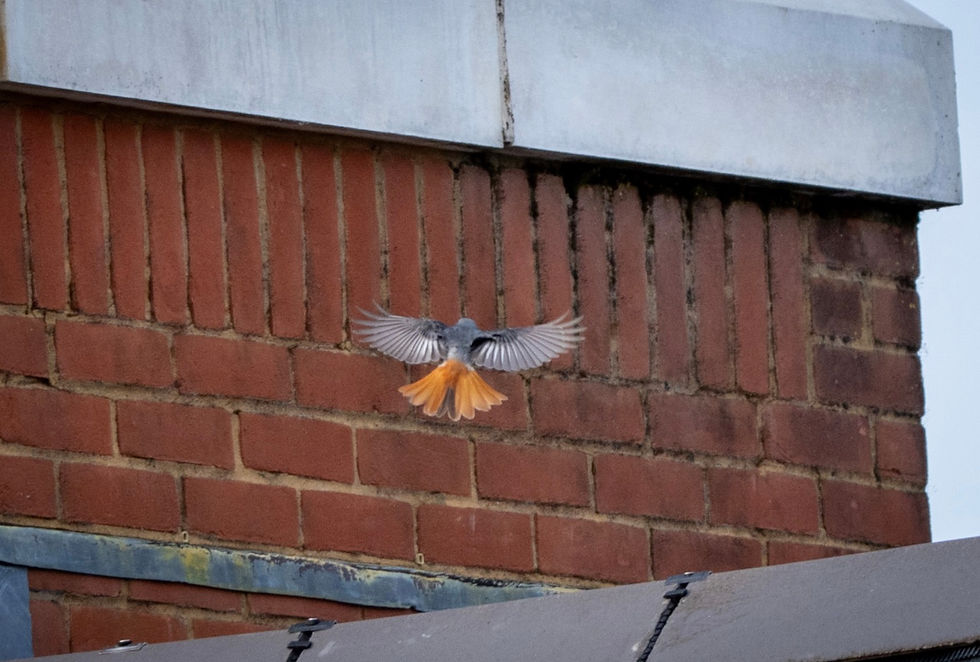
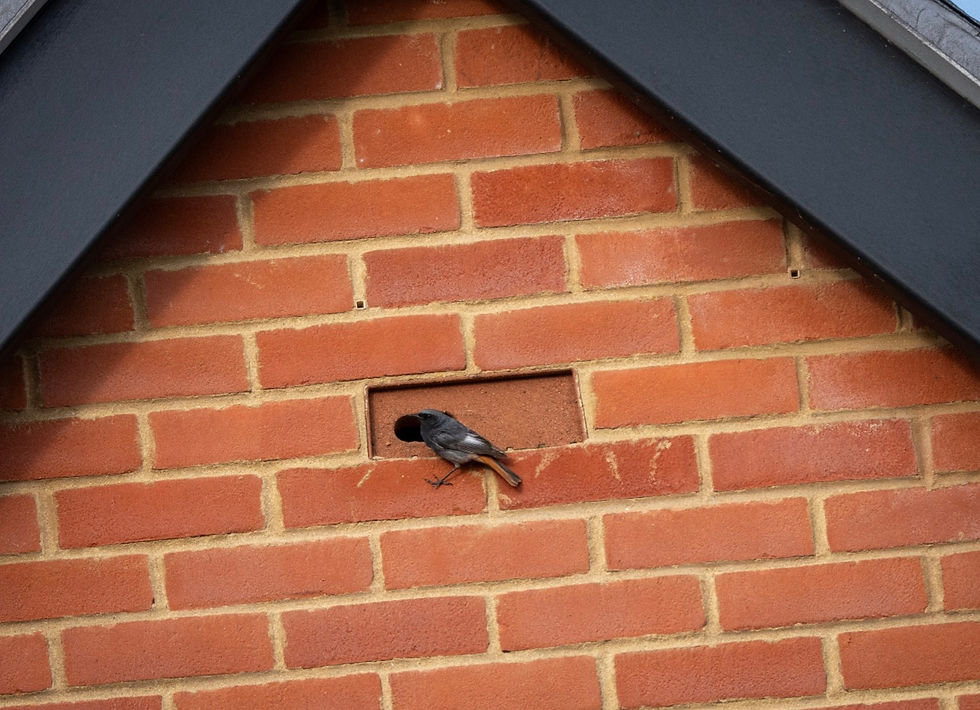
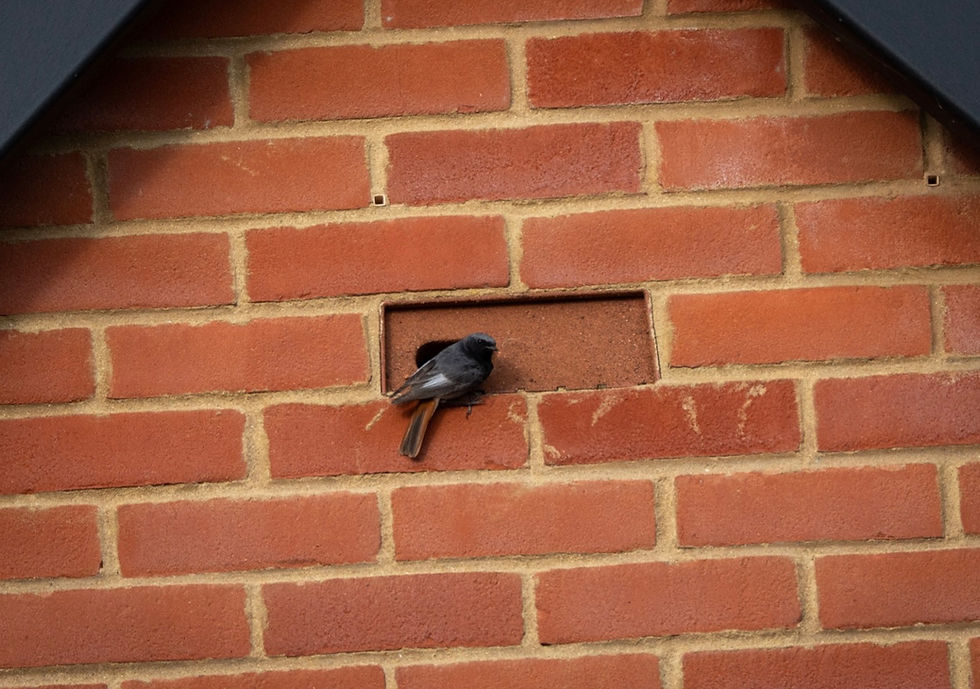
This April, a Winchester resident, Grant Mintram, was thrilled to discover that a pair of Black Redstarts were showing signs of nesting on the estate where he lives. Consistent with their known nest site preferences, this pair were exploring a gap in the brickwork of a building, but what was particularly striking was that this gap was the entrance to a swift brick. Swift bricks - also known as integrated nest boxes - are hollow bricks designed to be built into new buildings, or retrofitted, that provide nest chambers for Swifts and other small cavity-nesting birds including House Sparrows, Blue Tits, Great Tits, Starlings, Nuthatches and House Martins.4 Indeed such is the popularity of swift bricks as a nest site for a range of small cavity-nesting bird species that it is now recognized as a universal nest brick. But to our knowledge, this is the first time in the UK that a Black Redstart pair have been seen entering and exploring a swift brick with the apparent aim of nesting in it. The Manthorpe swift brick that attracted the interest of the Black Redstarts was developed by Barratt Homes in collaboration with the RSPB and Action for Swifts.5,6 It is a particularly spacious swift brick with a floor area of 413 cm2, and hence likely to be more appealing to Black Redstarts than the makes of swift bricks with a smaller interior. Although made of a combination of uPVC and polypropylene, the visible front of the Manthorpe swift brick has been ‘sanded’, making it more aesthetically pleasing to human eyes.
Modern building techniques mean that most houses built in the last 30 or so years are effectively sealed against birds. Such houses rarely have the gaps or crevices that Swifts and other small cavity-nesting birds need if they are to breed. Swift bricks are the solution to this. Current best practice guidance for home builders, laid out in a British Standard (BS 42021: 2022 Integral nest boxes) specifies that swift bricks must be installed in all new developments, with the number of swift bricks at least equal to the number of homes, i.e. the ratio of swift bricks to homes is 1:1. But although some developers adhere to these guidelines, particularly those home builders who are members of the Future Homes Hub Homes for Nature Scheme,7 many still build homes without swift bricks or any other feature that would have helped local wildlife, even when required to include such ecological features under the terms of planning approval.8 There has been a long-running campaign, led by the writer Hannah Bourne-Taylor, to make it mandatory to include swift bricks in new buildings. But as yet, only the Scottish Government has passed a proposal that swift bricks should be mandatory in new buildings. The UK government blocked the passing of a similar law last year.
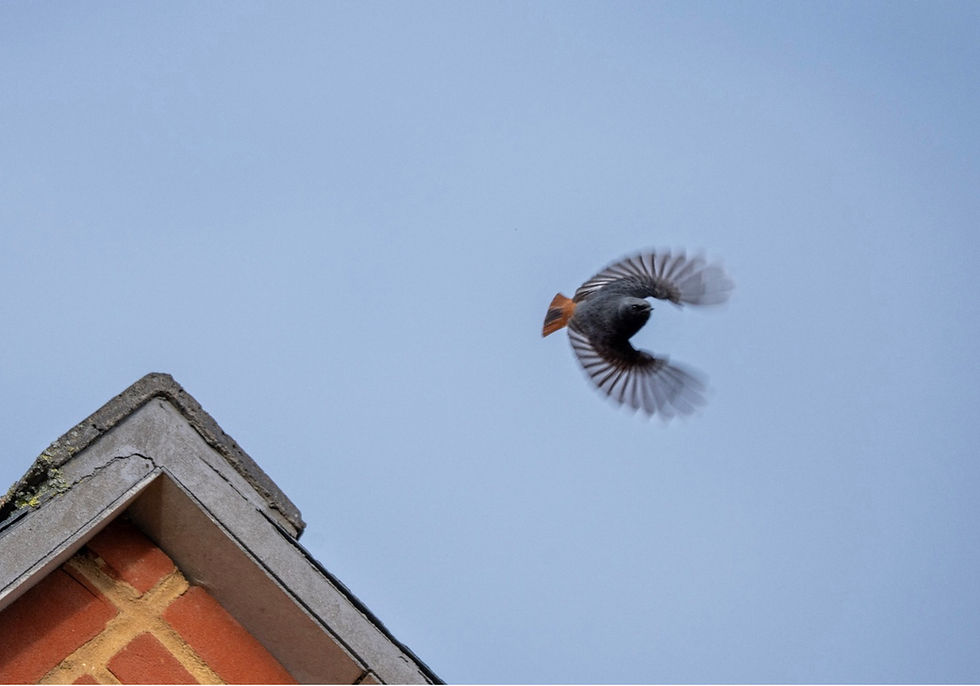
Fortunately for the Black Redstart pair in Winchester, they found a housing estate where the developers have been installing one swift brick per home on average for at least the last two years, along with other features for wildlife such as bat bricks, bee bricks and hedgehog highways. By supporting wildlife in these ways, these developers are giving the UK’s depleted biodiversity a chance to recover. They are also creating homes and living environments which people can share with nature. If the residents of these homes are very lucky - like Grant Mintram - they may even find that they have a pair of Black Redstarts as neighbours.
Catharine Gale, Hampshire Swifts
Acknowledgements
We thank Grant Mintram for allowing us to share his wonderful photos of the pair of Black Redstarts.
References
2. Eyre, J. (Ed.). (2015). Hampshire Bird Atlas 2007-2012. Hampshire Ornithological Society.
3. Hampshire Bird Report 2024 (2025). Hampshire Ornithological Society.